Would you like to make this site your homepage? It's fast and easy...
Yes, Please make this my home page!
thegreatuk.itgo.com -- Northern Ireland history and religion
This is a land of  blue mountains and forest parks, mazy lakes and windswept moors, white Atlantic sands, an inland sea.In fact, it's
a country that is just pretending to be small.

Dozens of small towns are hidden away down among the  green  places of  the country side, and fishing villages string out along the
shores. The towers and steeples of  parish churches mark the high ground beyond trimmed hedgerows. The country's turbulent past,
which still resonates today, has also helped shape the landscape.

Distinctive field patterns, for instance, are especially striking, and so are ruined castles. Built from the 12th century onwards, and
once symbols of both oppression and reassurance, they are now among Ulster's finest architectural treasures.

The Northern Ireland is only  5,500 square miles in area - about the size of  Yorkshire or Connecticut - you can see most of the main
attractions in a week without clocking up more than 500 miles.
Derry is one of the longest continuously inhabited places in Ireland. The earliest historical references date to the sixth century A.D.
when a monastery was founded there, but for thousands of years before that people had been living in the vicinity. These 'prehistoric'
people left traces of their existence in the various archaeological sites and objects which often come to light in this area.
The name Derry derives from the old  Irish  word  Daire  meaning an oak grove, particularly an oak grove on an island  totally or partly
surrounded by water or peat bog. Such was the case at Derry. The original oak grove which gave its name to the city and the various
settlements which followed it, were all located in turn on a small hill which was formerly an island in the River Foyle.
The channel which swept past the western side  of  that  island  gradually dried  out  leaving a marshy, boggy area. In time this area
became known as the Bogside. It is now one of the best known areas of the city.

Oak groves were sacred places for the Celtic peoples who once lived over most of Western Europe. 'Oak' placenames occur frequently
throughout the continent, as well as in Britain and Ireland. This reflects both the widespread nature of the ancient oak forests, and also
the important position these trees occupied in the culture and ceremonial of the Celts. Derry was almost certainly one of those Celtic
ritual places. The taboos and superstitions about the trees of Derry, which survived down to the sixteenth century, clearly hint at the
pre-Christian religious significance of this island hill.

St Columba's 'Long Tower' is another  very  important Derry church. It was  the  first Catholic church erected in the city after the
momentous events of the reformation and plantation. It is decorated in a brilliant neo-Renaissance style. Built originally in 1784,
St Columba's occupies the precincts of another of Derryls famous medieval churches the Tempull Mor or Great Church. This was
built in the 1160's at a time when a reasonably large township had grown up around the ancient monastery. The Tempull Mor
served as the cathedral of the Diocese of Derry throughout the middle ages. Like the distinctively Irish round tower of the same
period (hence 'Long Tower'), which stood nearby, all traces of the Tempull Mor disappeared in the seventeenth century.
Although the Vikings certainly sailed up the loughs and rivers of  this area, the monastery of  Derry escaped the worst effects of their
raids. Derry's medieval heydays were in the twelfth and thirteenth centuries when the local Mac Lochlainn dynasty moved into the
settlement. Under their patronage, Derry prospered: the population grew; the monastery and its school thrived; and prestigious
buildings were erected. With the decline of the Mac Lochlainns, some of whom claimed to be kings of all Ireland, Derry also sank into
unimportance.
In the sixth century A.D. a Christian  monastery was founded on  the  hill of  Derry. The site was allegedly
granted by a local king who had a fortress there. A similar kind of fortress can be seen at the spectacular
Grianan of Aileach, a few miles west of the city and now in County Donegal. According to legend the
monastery of  Derry was established by the great Irish saint Colmcille/Columba (521-597).
Colmcille founded many important monasteries in Ireland and Britain, including Durrow in the Irish midland
and Iona on an island off the west of Scotland. The claim that he founded Derry is less certain, although
that monastery definitely belonged to the federation of Columban churches which looked to Colmcille as
their spiritual founder and leader. The monastery of Derry would have been quite small at the beginning.
The location of the first church was probably where the beautiful little Church of Ireland Chapel of  St
Augustine stands today. During the later middle ages the old monastery of Derry evolved into an
Augustinian congregation. The church of that monastery survived up to the seventeenth century and was used,as their first place of
worship, by the London colonists who came here to build the walled city.

The famous skeleton on the city's coat-of-arms is said to depict  the association with another aristocratic
family the Norman de Burgos, who built their great fortress at Greencastle at the entrance to Lough Foyle.
They briefly owned part of  Derry in the early fourteenth century and may  well have been planning to build
a new  town there. Instead, the settlement declined in significance. When  the local O'Doherty family built
a castle in Derry for their overlords the O'Donnells, probably around 1500, it may well  have been  thought
that a new  beginning  was about to be made. The recently-built O'Doherty Tower  is a modern attempt to
commemorate that medieval association.

Throughout the second half of the sixteenth century, Queen Elizabeth I's military leaders tried to conquer the
province of Ulster, the only part of Ireland still outside English control. The English first came to Derry in 1566
but the garrison established there at that time lasted only a few years.
A second, more successful garrison returned in 1600 during the 'Nine Years War' against the Gaelic O'Neill
and O'Donnell earls.
On this occasion the English managed to hold on to Derry and, when the war came to an end in 1603, a small trading settlement was
established and given the legal status of city. In 1608 this 'infant city' was attacked by Sir Cahir O'Doherty (a previous supporter of the
English in Ulster), and the settlement was virtually wiped out.
This attack came about shortly after the so-called 'flight of the earls' when the O'Neill and O'Donnell chieftains, together with their
principal supporters, fled to the continent, leaving Gaelic Ulster leaderless.
The new king in London, James I, decided on a revolutionary plan designed once and for all to subordinate Ulster.
The 'Plantations in Ulster' required the colonising of the area by loyal English and Scottish migrants who were to be predominantly
Protestant in religion, unlike the Catholic Irish. One part of this colonisation was to be organized by the ancient and wealthy trades'
guilds of London.
The new county granted to the Londoners and its fortified city, built on the site of the recently destroyed settlement,were renamed
Londonderry in honour of this association.
The city of Londonderry was the jewel in the crown of the Ulster plantations.
It was laid out according to the best contemporary principles of townplanning, imported from the continent (the original street lay-out
has survived to the present almost intact). More importantly, the city was enclosed by massive stone and earthen fortifications Derry
was the last walled city built in Ireland and the only city on the island whose ancient walls survive complete.
Among the city's new buildings was St. Columb's Cathedral  (1633). This is one of the most important seventeenth century buildings
inthe country and was the first specifically Protestant cathedral erected in these islands following the Reformation.

The new city was slow to prosper. By the 1680's it still had only about 2,000 inhabitants; and yet it was, by far, the largest town in
Ulster. Along with most parts of Britain and Ireland, the city suffered from the upheavals in the 1640's.
In 1649 the city and its garrison, which supported the 'republican' Parliament in London, were besieged by Presbyterian forces loyal
to the King.
Among its most famous citizens in the second half of the seventeenth century was George Farquhar, one of the so-called Restoration
dramatists.

On April 18 1689, James came to Derry and summoned the city to surrender. The King was rebuffed and actually fired at by some of
the more determined defenders. As a policy no surrender' was confirmed, the Jacobite forces outside the city began the famous
Siege of Derry. For 105 days the city suffered appalling conditions as cannonballs and mortar-bombs rained down, and famine and
disease took their terrible toll.
The city was rebuilt in the eighteenth century with many of its fine Georgian style houses still surviving. George Berkeley, Ireland's
most important philosopher, was Dean of Derry (1724-33), and another well-known and eccentric cleric, Frederick Augustus Hervey,
the Earl of Bristol, was Bishop of Derry (1768-1803).
It was Hervey, the so-called  Earl  Bishop, who was responsible for building  the city's first bridge across the Foyle in 1790.
During the eighteenth and nineteenth centuries the port of Derry became an important embarkation point for Irish imigrants setting out
for America Some of these founded the colonies of Derry and Londonderry in the state of New Hampshire.
By the middle of the nineteenth century a thriving shirt and collarmaking industry had been established here, giving the city many of
its fine industrial buildings. Four separaterailway networks emanated from the city, the interesting history of which can be examined at
the Foyle Valley Railway Centre.

In 1921, with the partition of Ireland, Derry unexpectedly became a border city.
Amelia Earhart gave the city a much needed boost when she landed here in 1932 becoming the first woman to fly solo across the
Atlantic. Her connection with the city is reflected in a display at the Amelia Earhart Cottage at Ballyarnett.
In more recent times the city has become known worldwide on account of the 'troubles'. Less well-known is its reputation voted by
the Civic Trust in London as one of the ten best cities of its kind to live in, in the United Kingdom.
Derry is an old, beautiful city, set in a surrounding landscape of unparallelled natural beauty and diversity.
It also has an unparallelled wealth of history.
Faith And Belief In Northern Ireland
Christianity traditionally came to Ireland with St. Patrick in 432 CE, although there were probably pockets of the faith
before that.Ireland became Christian in quite a short time, incorporating a number of features from earlier religious
practice.

The Celtic Church had its own emphases, and laid great stress on scholarship. Many great manuscripts originated
in the Irish Church and Celtic crosses are reminders of the early Irish
Church.

At the Reformation, the Church divided and then Protestantism itself divided, into a number of denominations.
Political and religious identities began to be intertwined from about 1640 and this has not disappeared. Most churches are still
organised on an island-wide basis.
There is no established church in Northern Ireland. The Church of Ireland was disestablished in 1870.

Christianity in Northern Ireland tends to be traditional and conservative. Church membership and attendance at worship are
substantially higher than in the rest of the United Kingdom, although numbers belonging to the larger denominations are in decline.

Roman Catholic Church
Just over 600,000 people claim to be Roman Catholics in Northern Ireland, makingit the largest denomination.The Church
is divided into five dioceses: Armagh, Downand Connor, Derry, Clogher and Dromore, each presided over by a bishop.
Church of Ireland
The Church of Ireland is part of the Anglican Communion, and considers itself to be that part of Irish Church which was
reformed in the 16th century.
Methodist Church
John Wesley, the founder of Methodism, made 21 visits to Ireland, establishing a number of Methodist 'societies'. Many of
the members also considered themselves loyal members of the Church of Ireland and it was some time before a separate
Methodist denomination emerged.
Presbyterian Church
The second largest Christian denomination, and the largest Protestant Church in Northern Ireland. It began with the movement
of Scots to Ulster during the 17th century and it is still strongest in areas of Scottish settlement, such as North Antrim and
North Down.
Other Christian Denominations
There are a small number of Lutherans and Greek Orthodox in Northern Ireland, along with a great variety of Protestant denominations,
ranging in size from a couple of hundred members to almost 20,000.
Buddhism is a spiritual tradition that focuses on personal spiritual development and the attainment of a deep insight into
the true nature of life..
This makes Buddhism different to many other faiths, for it is not centred on the relation-
ship between humanity and God. Buddhism doesn't fi t the pattern of  other faiths, and
needs to be seen in its own terms to be understood properly. Buddhists do not believe
in a personal creator God. Buddhism does not have the concept of a Saviour, nor of
Heaven and Hell, in the popular sense.
Buddhism doesn't demand blind faith, or belief, and says that people should test its teachings against personal experience.

There are about 100 Buddhists here - some of them Irish people who were attracted to the religion but they also include about 30
Tibetan Buddhists, who live in the Greater Belfast area.
Islam was revealed to humanity through the Prophet Muhammad (pbuh) during the 7th century CE, in Arabia, and spread
rapidly through the Middle East. Although Islam was not fully revealed to us until the 7th century, Muslims believe that it
has always existed. Everything belongs to God.
                                                                                   The word Islam means submission to Allah (God), and Muslims
                                                                                   believe that everything in life should be at the service of Allah.
                                                                                   As a result, Muslims find it hard to accept the distinction that
                                                                                   Western cultures make between a person’s religious life and
                                                                                   the rest of their life.

They believe that not only individuals, but also the institutions of society, should serve Allah. Muslims submit to Allah by obeying his
commands, and by living their whole lives in a way that is pleasing to Allah.

The Muslim community in Northern Ireland has grown from less than 100 members, in 1970, to about 2,500 at present. The majority
have come from India and Pakistan but a large number of other nationalities are represented, along with some people from Northern
Ireland who have converted to Islam. The majority of Muslims live in the Greater Belfast area and many work in medicine and
education.
The mosque and community centre is in Belfast.
Hinduism
Hinduism' is not a term which identifies a single set of beliefs, or ways of worship. Indeed, theword itself doesn't appear in
English until 1829.Hinduism covers the practices of a variety of different religious groups which come out of India.
Origins Hinduism developed from the religious practices of those who lived near the river Indus in modern day Pakistan.
However, Hinduism has been, and continues to be, influenced by the traditions, stories and practices of people from
 There are about 3,000 Hindus in Northern Ireland, mainly in the Greater Belfast area but with smaller
communities in Londonderry and around Magherafelt. Most of them came from one, fairly small, area of the Punjab. A number have
made their mark on the business life of Northern Ireland.
There are about 3,000 Hindus in Northern Ireland, mainly in the Greater Belfast area but with smaller
communities in Londonderry and around Magherafelt. Most of them came from one, fairly small, area of the Punjab. A number have
made their mark on the business life of Northern Ireland.
The Hindu Temple was established, in 1979, in a former Methodist Church in Belfast, along with the Indian community centre.
Regular worship takes place there and the centre provides a wide variety of cultural, musical and community events.
One branch of Hinduism, Hare Krishna, has a temple just outside Belfast and its membership includes a number of Irish people.
The group also has a centre on a County Fermanagh island, but this community is moving away.
other parts of India and beyond.
John Wesley, the founder of  Methodism, made 21 visits to Ireland, establishing a
number of Methodist 'societies'. Many of the members also considered themselves
loyal members of the Church of  Ireland and it was some time before a separate
Methodist denomination emerged.
The Church’s governing body is the Conference, meeting once a year.
Just over 600,000 people claim to be Roman Catholics in Northern Ireland, making it the largest denomination.
The Church is divided into five dioceses:Armagh, Down and Connor, Derry, Clogher and Dromore, each presided over by
a bishop. Some of these dioceses also have territory in the Republic.
The  Archbishop of Armagh, the Most Rev. Dr. Sean Brady, is Primate of all Ireland.
Armagh was the site of one of Patrick’s first churches and it has become known as the ecclesiastical capital of Ireland.

                The Church is organised into parishes - each with a parish priest and often one or two curates.
                The centre of parish life and worship is the regular celebration of the Eucharist or Mass - the same service
                that takes place all over the world. It has its own school system - often called the 'maintained sector' with
                schools based on the parish or small groups of parishes.

Sikhism is the youngest of the great world faiths. There are 20 million Sikhs in the world, most living in India. Sikhism is
Britain’s third most popular religion, with about half a million Sikhs living in the UK. Sikh men are easily identified by their
beards and turbans, which are an outward sign of their religious identity.
The most important thing in Sikhism is the internal religious state of the individual. Sikhs avoid superstitious behaviour
and pilgrimages, statues, buildings, and 'blind' rituals.
Sikhs think religion should be practised by living in the world,and coping with life's everyday problems. They don't approve of retreating
from the world to be a monk or a hermit.
Community Centre was established in Londonderry. Religious meetings are held in the Temple,                along with other musical
and cultural activities.
The Church of Ireland is part of the Anglican Communion, and considers itself to be that part of the Irish Church which
was reformed in the 16th  century.
It owns such medieval church buildings as there are in Northern Ireland. Its government by bishops is similar to that of
the Roman Catholic Church and the Archbishop of Armagh and Primate of all
Ireland, the Most Rev. Dr. Robin Eames,               is a significant figure in world-wide Anglicanism.
Generally speaking, the Church of Ireland in Northern Ireland would emphasise the 'Protestant', or Reformed, part of its heritage.
                                                   Its worship would normally be considered quite 'low church', with the Irish version of the Book of
                                                   Common Prayer and a modern liturgy, The Alternative Prayer Book, being used. Holy Communion
                                                   is celebrated weekly or monthly; other services include Morning and Evening prayer.
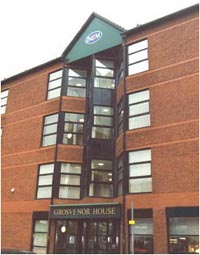
Grosvenor
House. Head Quarters of The Methodist Belfast Central Mission
| Northern
Ireland History And Religion |
Beneath this there are a number of districts. Each district is made up of a number of circuits, the equivalent of parishes or
congregations. The President of  the Methodist Church in Ireland serves for a 12 month period. Methodists in Ireland, as elsewhere,
have traditionally married evangelistic outreach with social concern. This can be seen clearly in the development of 'city missions' of
which the Belfast Central Mission is probably the best known in Northern Ireland.
For more information:- Search --- britannia.com


