Would you like to make this site your homepage? It's fast and easy...
Yes, Please make this my home page!
thegreatuk.itgo.com -- Scotland Musuem And History
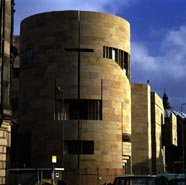
A striking  new landmark in Edinburgh's historic Old Town, this magnificent building was designed by
Benson + Forsyth.The Museum of Scotland presents for the first time the history of Scotland its land
its people and  their achievements - through  the rich national  collections .The stunning  series of
galleries take you  from Scotland's geological beginnings through time to the twentieth century.
Virtual Musuem of Scotland
-
England and  Scotland  were  linked through James VI of  Scotland acceding to the English throne in 1603, following the death of
Queen Elizabeth I (of England). Elizabeth had persecuted (and finally executed) James' mother and her own cousin, Mary Queen
Of Scots, but died childless.
-
Succeeding English monarchs were not as well disposed towards Scotland as James had been. Following the formal Act of Union
in 1707, displeasure  particularly  amongst Highland Scots, supported the rebellions of  1715 and 1745 which attempted to restore
respectively the Old and Young (Bonnie Prince Charlie) Pretenders to the throne of Scotland.
-
After the 1745 rebellion, which  was effectively a Civil War, the Highland  Clearances  began. Thousands were evicted from their
rented crofts and  the Mass migration of  Scots to other parts of  the world began. Despite the popularist view that the landlords
were English, the  majority  were Scots, but  not those of  the gaelic - speaking Roman Catholic tradition who had fought for the
'Bonnie Prince'.
The lid of a safe or treasure chest owned by the former Darien Company in 1695 is one of the most
intriguing exhibits in the Museum of Scotland. Its lock comprises fifteen elaborate bolts activated by
single key. Since the mid - 19th century, how ever the lid of  the chest-given to the former National
Museum of Antiquities of Scotland in 1864- as been separated from its base, owned by the Bank of
Scotland. On 17 July Sir John Shaw, Governor of the Bank of Scotland, generously presented the
base section of the chest to the National Museums of Scotland so that the two parts could finally be
reunited. The Darien Chestis now on show on Level 1 of theMuseum of Scotland.
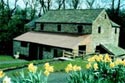
The Museum of  Scotland  begins with  the  story  of Scotland's landscape and  wildlife. You will find at the east
end of Level 0. The  first  part of  Beginnings shows  how  the piece of  land we now call Scotland journeyed over
the  earth's  surface and  changed  dramatically in shape, landscape and climate. The story is  told  through the
evidence  that  is  found in the  rocks. These  changes  happened  hundreds of  millions of  years before the first
people arrived, but the resulting landscape influenced the wildlife and the human history that followed.
The second part explores the history of Scotland's wildlife after the last Ice Age. It is a story of change, survival
and extinction. An evidencetrail shows how we can interpret the evidence of the present in order to recreate the
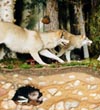
past. There are specimens that can be touched.Specially commissioned paintings, models of extinct  animals,
dioramas and  audio-visual  programmes vividly  illustrate scotland's earliest history.
The
Scottish Life Archive
This archive is based in the Royal Museum of Scotland,Chambers Street, Edinburgh.It was founded in 1959 with the aim of preserving
documentary and illustrative material, and in particular  the details of social and economic life that can easily be neglected.It is part of
the National Museums of Scotland and provides context to the social history collections
The collection consists of photographs, slides, postcards and film; drawings and maps; audio tapes; manuscript
sources such as diaries, letters, and account books; news paper cuttings, bibliographies and other notes.
The aim is for the archive material to demonstrate  sequences of change, not only through
material remains but also by examining  the infrastructure of society, e.g.communications
or migration.The main emphasis has been on rural and maritime issues, but the Archive is
now expanding its collection on urban and industrial life.
Edinburgh, the capital of Scotland , is one of the most beautiful cities in Europe.This distinction is partly an
accident of Nature, for the city is built upon a jumble of hills and valleys; however, during the eighteenth and
nineteenth centuries the natural geography was enhanced by the works of a succession of distinguished -
Georgian and Victorian architects.The result today is high drama; thereare countless spots where Edinburgh
looks  less  like a city and more like a theatrical backdrop. The view from Edinburgh's Calton Hill, across the
River Forth to Fife, looks more like a scene from ancient Rome....
Edinburgh  incidentally, is  named  after  Edwin, a  king  of  ancient  Northumbria; it has been a Royal Burgh since at least the twelfth
century, and has been recognised as the capital of Scotland since the fifteenth.

Edinburgh's face is her fortune, for it was this dramatic beauty  which, in  the first instance, made  the Scottish capital's name familiar
throughout the modern world. But  there are other, less tangible factors involved, for  Edinburgh is a city that delights the mind as well
as the eye. It is a city where the past lives comfortably with the present. It is a gracious place, in the way that many other cities used
to be.

Perhaps it is for its Castle which Edinburgh is famous, certainly in the eyes of countless tourists.
The villages of Midlothian and East Lothian are remarkable in terms of their ancient charm.The photograph shows the ruined
churchyard  in the appropriately named  village of  Temple, which  nestles in a sheltered  hollow almost hidden from passing
tourists.
Aberdeen City of Scotland
Aberdeen has something for everyone.  Its  rich  cultural  heritage  combines  with  a  thriving contemporary  community and a strong
economic pulse,  to make the . Granite City a lively and rewarding place in which to live and study.

Nestling on the coast at the confluence of the rivers Dee and Don, it is a compact city with  a population of 216,000. Renowned for its
splendid granite architecture,it sparkles like a jewel on the edge of the North Sea, bordered by cultivated farmland, wild moors,
beautiful beaches and rugged hills.

Aberdeen is a vibrant and cosmopolitan city,  welcoming  business  people and  their  families from throughout the world. Its buoyant
economy is the result of diverse commercial activities - including trading, tourism, farming  and  fishing - which  sustain a high quality
of lifestyle. More recently, it has become the hub of the world'soffshore energy network and is the off-shore oil capital of Europe.

As a university city,  Aberdeen  has always taken the student  population to its heart. It has much to offer in the way of entertainmen
and leisure, at a range of costs to suit every pocket. The city centre has several busy shopping malls - designer boutiques, major,
chain-stores, charity shops and antique and speciality shops - as well as a wide choice of nightclubs, wine bars, traditional pubs and
restaurants. The city has a thriving nightlife. Cinema-goers also have plenty of choice.

Culturally, Aberdeen caters for all tastes .His Majesty's Theatre, a magnificent  Edwardian  building, attracts  international companies
performing ballet, theatre, opera and light entertainment.The concert halls regularly feature classical, contemporary and rock concerts.
Exceptional museums and an art gallery, including the University's museums and collections, display  the  visual  arts, local  heritage
and  visiting  exhibitions. The popular Lemon  Tree  venue, with its  café-bar atmosphere, attracts an exciting mixture of contemporary
theatre, dance, stand-up comedy and music.

There  are  excellent  facilities  for  sports  lovers - from indoor leisure centres to golf courses; horse riding to windsurfing; as well as a
range of national league sports  for  those  who  prefer to  spectate. Only in Aberdeen can the dedicated sports fan achieve the feat of
windsurfing at the beach and ski-ing in the mountains - all in a single day!

There are miles of  golden  beaches, dunes and cliffs, which  give  shelter  to  great colonies of seabirds and winter
migrants. The nearby Cairngorm  mountains  offer superb  opportunities for hillwalking, mountaineering and ski-ing,
and rivers such as the Dee, the Don, the Ythan and the Ugie offer fishing, rowing, canoeing,as well as breathtaking
scenery.

Getting about is easy in Aberdeen, which has excellent bus services giving access to all parts of the city and suburbs. But distances
are short and a pleasant walk or a brief cycle run are reliable alternatives. Cheap and regular rail, bus and air links will get you around
Scotland and the UK - London is a little over an hour away by plane.


Dundee is a lively, affordable, friendly city boasting 2 universities and a population of 143,000 set in a
dramatic  location  at  the  mouth of  the  River Tay on Scotland's east coast, Dundee is the regional
centre for Tayside - one of the most affluent and unspoilt areas of the British Isles.

Once Britain's premier whaling port and the hub of the world textile trade, Dundee is now a flourishing
centre for life sciences research, the arts, business, education, hi-tech manufacturing, telecommun -
ications and tourism.

With more hours of  sunshine, the purest air  quality and  more green spaces than any other Scottish
city, Dundee provides an unrivalled quality of life.

Dundee's strategic location commands rapid and easy access to the central  belt, the Highlands and
the three other  major centres of  population in  Scotland - Aberdeen (67 miles), Edinburgh (60 miles)
and Glasgow (79 miles). Over 90% of Scotland's population live and  work less than 90 minutes' drive
away.

Businesses, tourists, students and  visitors from the USA, Japan, France, Belgium, Australia, China,
Norway, Sweden and  India  have all made  the  Dundee decision - attracted by a prime quality of life,
excellent skilled workforce and tailored office and factory accommodation at competitive prices.

Dundee is the home port of the Antarctic exploration vessel the Royal Research Ship Discovery which
took the ill-fated Captain Robert Scott and his crew on their first voyage to Antarctica in 1901.

The  RRS  Discovery  lends  her  name  to  the  City of Discovery Campaign, an award-winning image-
building initiative which has in recent years helped transform Dundee from a "post industrial backwater
to a city of arts and science."
Scotland is divided  into  three  main  regions; the Highlands, the Midland Valley and the Southern Uplands. The cities of Edinburgh,
Glasgow and Dundee together with numerous towns, most of the population and the majority of Scotland's industry is located within
the Midland Valley.
The official language is English, although Gaelic is spoken, primarily in the North and West of Scotland.
Scotland includes 787 islands, of which most belong to groups known as the Hebrides, Orkney and Shetland.
Only 62 exceed three square miles in area.
26 rivers flowing directly  into the sea. The Rivers Clyde, Forth and Tay open into significant estuaries and support three of the major
cities of Scotland (Glasgow, Edinburgh and Dundee respectively).


 Scotland History
-
The Midland Valley of  Scotland  represented  the most northern extent of the Roman conquest of Britain after 79 A.D. Remnants
of the Antonine Wall, which the Romans built between the RiverForth and the River Clyde to defend this frontier, can still be seen.
The lands to the north (known to the Romans as Caledonia) were occupied by a war-like tribe called the Picts.
Little is known of the Picts, but their origin and language is most-likely Celtic. The more famous Hadrian's Wall, which is over 100
miles long and lies close  to the current  border between England and Scotland, was built by the retreating  Romans (having been
harried by continuous Pictish attacks) around 119 A.D.
-
In the  5th Century  the "Scots" came  from  their  home  in  Ireland  and  settled  in  the  West  of  Scotland. The Scots, partially
christianised when they came, had Saint Columba as their great missionary, and through him and his followers,built on the work
of  Saint Ninian converting  the Picts and other tribes to christianity. Saint Columba is buried on the sacred island of  Iona off the
west coast of Scotland.
-
After centuries of wars with the Picts, they put the crown of Scots and Picts on the head of their king, Kenneth MacAlpin, in 843.
-
The reign of  Malcolm Canmore (1057 - 93) was a time of  great social, political  and religious revolution. Malcolm had spent much
time in England and he and his saintly queen (Margaret) encouraged the introduction of  english customs, civilisation, the english
language and settlers. Many Normans (the normans having conquered England in 1066) brought French culture to Scotland.
| Scotland
Museum And History |
For more information:- Search --- britannia.com
The major cities of scotland are :
- Glassgow
- Edinburgh (The capital city of scotland)
- Aberdeen
- Dundee
Glassgow City Of Scotland
Glassgow is Scotland's biggest city, with a population of almost  612,000. Glassgow is the best UK shopping center outside london
and has excellent business cultural, sport and tourist facilities;That's why the city was European city of culture 1990 and in 1999 UK
city of architecture and design
On the left  is a  photograph is taken from the air, showing part of  central Edinburgh, particularly
the area around the University of Edinburgh. The lens-shaped green  park in  the centre is known
as the Meadows. The  large  park  with  the distinctive  hills towards the right of  the image is the
Queen's Park, containing Arthur's Seat and Salisbury Crags.
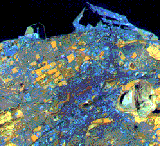
On the right is a satellite image, showing Edinburgh. Arthur's Seat is visible in the centre-right, with the
Meadows below and to the left (orange).
Edinburgh Capital City of Scotland
Welcomen to  the Official City of  Edinburgh Tour. Here  we attempt to give  you a very brief flavour of  the City and some of  its most
Famous features.