Great Britain is the term used for the island containing the contiguous nations¹ of England, Scotland and Wales. Great Britain is used
to distinguish Britain from Brittania Minor, or Brittany, in France. The term "Great Britain" was officially used only after King James I
(who was also James VI of Scotland) acceded to the throne of England and Wales in 1603, styling himself King of Great Britain
although legislative union between Scotland and England did not take place until 1707.
England, Scotland and Wales together with the province of Northern Ireland, form the country officially known as "The United Kingdom
of Great Britain and Northern Ireland" or simply the United Kingdom.
The United Kingdom came into being in 1801 following the Irish Union, although the greater part of Ireland gained independence in 1921
to form the Irish Republic (or Eire). The majority of the people in Northern Ireland have wished to remain part of the U.K., although a
minority wish unification with the Irish Republic.
The term "England" is sometimes erroneously used by both natives of England (the English) and those outside our country to refer to
the United Kingdom. Natives of the other constituent nations of the U.K. find such usage offensive, so it is best avoided! Although there
is no adjective for the "United Kingdom" the term "British" is acceptable, although has to be used with care and sensitivity in Northern
Ireland, where one section of the community would be happy being so-described, whereas the other would most definitely regard
themselves as "Irish".

The United Kingdom does not include the Isle of Man (which lies between Great Britain and the island of Ireland) and the Channel
Islands (which lie off the North coast of France). These are direct dependencies of the British Crown, maintaining their own legislative,
monetary and taxation systems. Each have their own parliaments and a Governor, appointed by the Crown.
The British Isles is used more loosely to describe the main island of Great Britain together with its associated islands (including the
Isle of Man). It has no legal significance.

The Channel Islands, which include the independent States of Jersey, Guernsey, Alderney and Sark, are the only remaining
components of the "Duchy of Normandy" which still belong to the British Crown.
British Incised Slabs 13th to 15th Centuries
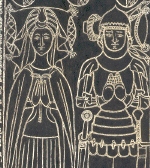
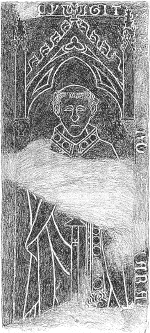
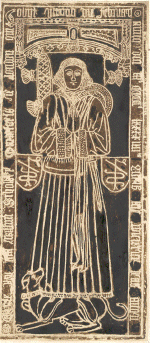
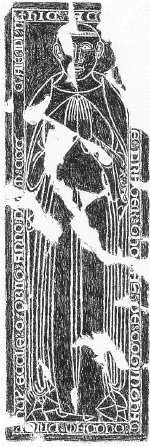
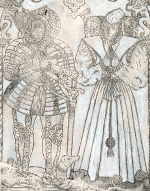
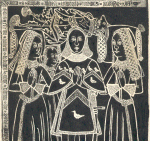
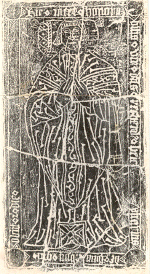
Effigial incised slabs appeared in England before the Norman Conquest, but only survive in significant numbers from the late fourteenth
century. Their increase in popularity at the expense of cross slabs may probably be due to the increasing importance of the Doctrine
of Purgatory and the consequent need for personalised commemoration. The slabs at Mansfield, St. Bees, Edvin Ralph and St. Brides
Major are examples of this surge in popularity of this monumental type. Slabs vary in quality, from poor work like that at Drayton, to
high-quality works, like the fragmentary remains of the slab at Lincoln to Richard Gaynesburgh, architect of the Angel Choir. By the
second half of the 15th century, the Midlands alabaster workshops were turning out large numbers of slabs of distinctive design and
reasonable quality, like those at Newbold, Pusey and Scropton.
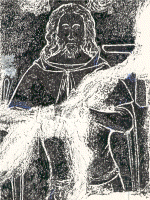
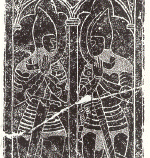
Two knights of  the Turin family
     1411, Fovran, Scotland
     Thomas Boughton, 1454,
Newbold-on-Avon, Warwickshire
Richard de Gaynesburgh, c. 1340
      Lincoln Cathedral
Henry Dogett, 1491,Pusey,Berkshire
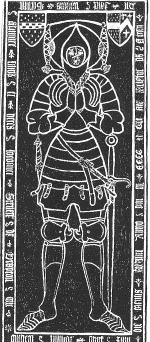
William Grevell esq, 1440,
    Drayton, Oxfordshire
     Unknown priest with chalice,
c.1280, Mansfield, Nottinghamshire
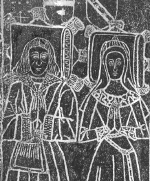
William Schower, 1495, Scropton,
                Derbyshire
Prior Thomas de Cotynghamc.
1300, St. Bees, Cumberland
British Incised Slabs 16th to 18th Centuries
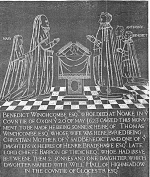
Early 16th century incised slabs in Britain include very fine examples like that at Blithfield and others of mediocre quality, as at
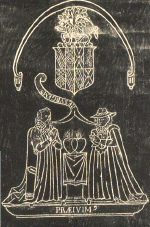
Oathlaw. Late 16th century slabs often include much fussy detail, but later slabs, which are often mural rather than floor memorials,
are simpler and more pleasing. Amongst early 17th century examples, the simple slab at Beaconsfield and the more complex
composition at Chalgrove deserve to be better known. Unusual designs were often found in a limited area, suggesting the work of local
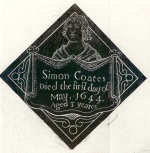
craftsmen. At Thame, are two lozenge-shaped slabs of white marble to children of the Coates family who died in infancy; Simon
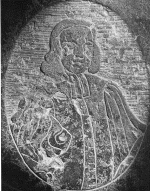
Coates was only 3 when he died. The 1716 slab to Robert Cowcher, with a low relief figure in a recessed medallion, is another
distinctive local type.
Economy - overview The UK, a leading trading power and financial center, deploys an essentially capitalistic economyone of the
quarter of trillion dollar economies of Western Europe. Over the past two decades the government has greatly reduced public owner-
ship and contained the growth of social welfare programs. Agriculture is intensive, highly mechanized, and efficient by European
standards, producing about 60% of food needs with only 1% of the labor force. The UK has large coal, natural gas, and oil reserves:
primary energy production accounts for 10% of GDP, one of the highest shares of any industrial nation. Services, particularly
banking, insurance, and business services, account by far for the largest proportion of GDP while industry continues to decline in
importance. Economic growth has been slowed in 1999; recovery to 3% is in prospect for 2000, base on arise in exports and
domestic demand.
GDP purchasing power parity - $1.29 trillion (1999 est.)
GDPreal growth rate 1.9% (1999 est.)
GDP - per capita purchasing power parity - $21.800 (1999 est.)
GDP - composition by sector agriculture 1.7%
industry 25.3%
services 73% (1998)
Population below poverty line 17%
Household income or consumption by percentage share
lowest 10%:2.4%
highest 10%:24.7% (1986)
Inflation rate (consumer prices) 2.3% (1999)
Labor force 29.9 million (1999)
Labor force by occupation services 68.9% manufacturing and construction 17.5%, government 11.3%, energy 1.2%
agriculture 1.1% (1996)
Unemployment rate 6% (1999)
Budget revenues: $541 billion expenditure: $ 507.5 billion, including capital expenditure of $ 35.1 billion (FY98/99)
Industries production machinery including machine tools, electric power equipment, shipbuilding, aircraft, motor vehicles and parts,
electronics and communications equipment, metals, chemical, coal, petroleum, paper and paper products, food processing, textiles
clothing, and other consumer goods.
Industrial production growth rate -0.3% (1999)
Electricity - production 343,099 billion kWh (1998)
Electricity - production by source fossil fuel: 68.24%
hydro: 1.49%
nuclear: 28.48%
other: 1.79% (1998)
Electricity - consumption 331,482 billion kWh (1998)
Electricity - exports 200 million kWh (1998)
Electricity - Imports 12.6 billion kWh (1998)
Agriculture - products cereals, oilseeds, potatoes, vegetable; cattle, sheep, poultry; fish.
Exports $271 billion (f.o.b., 1998)
Exports - commodities manufactured goods, fuels, chemicals; food, beverages, tobbaco.
Export - partners EU 58% (Germany 12%, France 10%, Netherlands 8%), US 13% (1998)
Imports $305.9 billion (f.o.b., 1998
Imports - commodities manufactured goods, machinery, fuels; foodstuffs.
Import - partners EU 53% (Germany 13%, France 9%, Netherland 7%, Italy 5%), US 14% (1998)
Currency 1 British pound =100 pence
Exchange rate British pounds per US$1 - 0.6092 (January 2000), 0.6180 (1999), 0.6037 (1998), 0.6106 (1997), 0.6403 (1996),
0.6335 (1995)
United Kingdom Population:-
Infant morality rate 5.63 deaths/1,000 live births (2000 est.)
Life expectancy at birth total population:77.66 Years
male:74.97 Years
female:80.49 Years (2000 est.)
Total fertility rate 1.74 children born/woman (2000 est.)
Ethnic groups English 81.5%, Scottish 9.6%, Irish 2.4%, Welsh 1.9%, Ulster 1.8%, West Indian, Indian, Pakistani, and other 2.8%
Religions Anglican 27 million, Roman Catholic 9 million, Muslim 1 million, Presbyterian 800,000, Methodist 760,000, Sikh 400,000,
Hindu 350,000, Jewish 300,000 (1991 est.)
Languages English, Welsh (about 26% of the population of Wales), Scottish form of Gaelic (about 60,000 in Scotland)
Total population:99% (1978 est.)
Population 59,511,464 (July 2000 est.)Age structure 0-14 Years:19% (male 5,816,313: female 5,519,479)
15-64 Years:65% (male 19,622,152: female 19,228,938)
65 Years and over:16% (male 3,864,612: female 5,459,970) (2000 est.)Sex ratio at birth:1.05 male(s)/female
under 15 Years:1.05 male(s)/female
15-64 Years:1.02 male(s)/female
65 Years and over :0.71 male(s)/female
total poulation:0.97 male(s)/female (2000 est.)
United Kindom Geography:-
Location Western Europe, islands including the northern one-sixth of the island of ireland between the North Atlantic Ocean and the
North sea, north west of France.
Geographic coordinates 54 00 N, 2 00 W
Area total:244,820 sq km
Land:241,590 sq km
Water:3,230 sq km
note: include Rockall and Shetland Islands
Area - comparitive Slightly smaller than Oregon
Land boundaries total:360 km
border countries:Ireland 360 km
Coastline 12,429 km
Elevation extremes lowest point:Fenland -4 m
highest point:Ben Nevis 1,343 m
Natural resources coal, petroleum, natural gas, tin, limestone, iron ore, salt, clay, chalk, gypsum, lead, silica, arable land.
Land use arable land:25%
permanent crops:0%
permanent pastures:46%
forests and woodland:10%
other:19% (1993 est.)
Irrigated land 1,080 sq km (1993 est.)
Natural hazards NA
The area total some 242,500 sq km. Britain is just under 1,000 km long from the south coast of England to the extreme north of
Scotland, and just under 500 km across in the widest part.

With some 57 million people, Britain ranks sixteenth in the world in terms of population. Britain is a relatively densely populated
country. England has the highest population density of the four lands and Scotland the lowest
.
According to a United Nation reports on human development published in 1992, Britain ranked tenth out of 160 countries on a human
development index that combines life expectancy, education levels and basic purchasing power.